 NOVA
NOVADiplomacy
You are not alone in the galaxy. Nova lets you talk to the other commanders and strike deals with them. Diplomacy is a whole parallel game: an alliance held together by a few messages, or a well-timed bribe, can decide a theatre as surely as a fleet.
Diplomacy has two tools — messages and contracts — both in the Diplomacy panel. Both keep working even while the theatre is paused, so you can negotiate around a break.
Messages
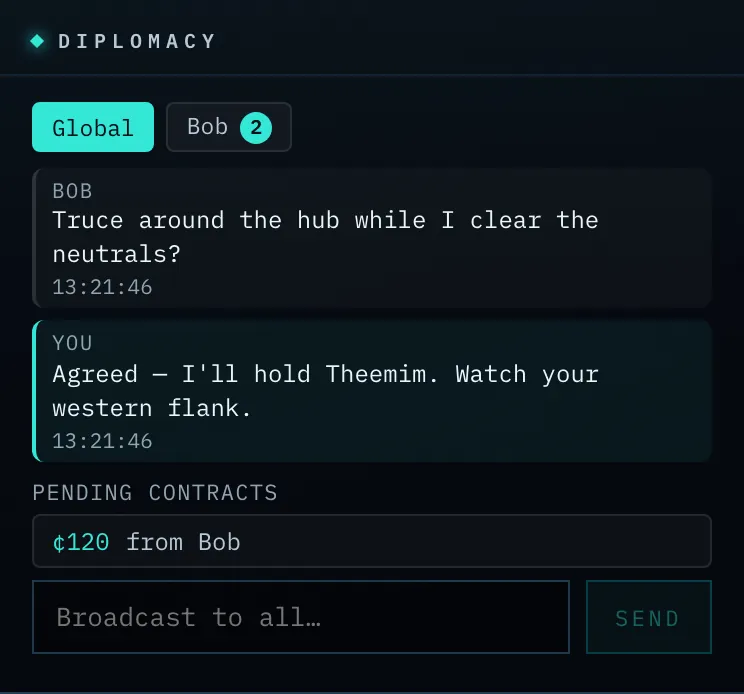
A message is simply text you send to another commander. There are two kinds of channel:
- Global — a broadcast that every commander in the game can read. Use it for public declarations, taunts, or an open call for allies.
- A private thread — a one-to-one conversation with a single commander. Only the two of you can read it. There are no group chats; a private message has exactly one recipient.
Open Diplomacy, pick the Global channel or a commander's thread, type your message (up to 2,000 characters), and press Send. New messages notify you in the app and by push, and each channel carries an unread badge so you can see who is waiting on a reply. Pause-and-resume requests are logged in the Global channel too, so it doubles as the theatre's public record.
Contracts
Talk is cheap; a contract puts credits behind it. A contract is a formal offer of payment from one commander to another, made inside a private thread. Press OFFER beside the message box in a commander's thread — or Offer a contract… in the Global channel, which first asks which commander the offer is for. Then set it up:
- Amount (¢) — the credits you will pay.
- Optionally add a condition — what they must do to earn the payment:
- Only if they send a fleet — you name a From star, a To star, and a number of Ships, and the payment happens only if that exact fleet is sent.
- Only if they transfer a star to me — you name one of their stars, and the payment happens only if they hand it over, ships out of the way.
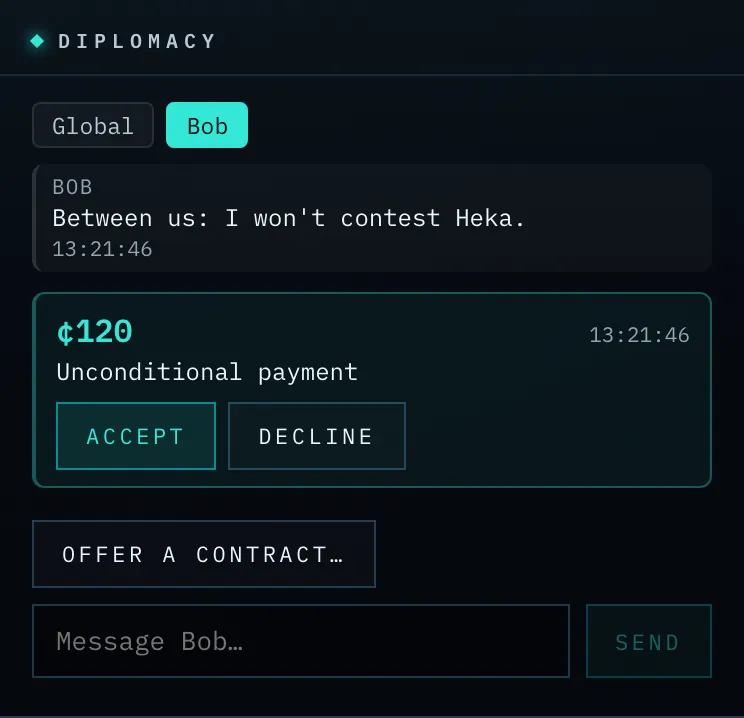
Send the offer and the other commander sees an actionable card in the thread with Accept and Decline; you can Withdraw it while it is still pending.
How a contract settles. Accepting doesn't move anything by itself — it locks the deal in, and a moment later the theatre carries it out whole, or not at all. If any part turns out to be impossible when that moment comes, the contract is marked FAILED, nothing moves — no credits, no fleet, no star — and both of you read why in the thread. A failed contract is over; make a new offer if you still want the deal.
- Unconditional — the credits move from you to them.
- Conditional (send a fleet) — the credits move and the fleet you named departs on their behalf, as one deal.
- Conditional (transfer a star) — the credits move and the star — with its wealth, factories, and shields, but no ships — becomes yours. Before it changes hands, the seller chooses where their garrison goes: any star in range of the one being sold (an ordinary dispatch — landing on someone else's star is an attack), or nowhere. The evacuation fleet leaves first; then the star is handed over and whatever ships remain on it are destroyed — the buyer takes an empty star. The sale also cancels the seller's fleets still waiting to depart it, and clears everyone's standing orders on that star except the buyer's own.
A few rules worth knowing:
- No escrow at offer time. The money is not set aside when you offer — affordability is checked when the other commander accepts. From acceptance until the deal settles, though, the payment is held, so a second deal can't spend the same credits.
- A contracted fleet cannot be recalled. Once accepted, that dispatch is locked in.
- The terms are private, the hand-over is not. Only the two of you ever see the amount and condition — but a star changing hands is visible to everyone: the map recolors, and the star's history reads "«star» was ceded to «buyer»". You cannot sell a star quietly.
- Offers expire after 24 hours of real time. An unanswered offer lapses, and the thread notes it.
Why bother?
Diplomacy turns a free-for-all into a game of alliances and leverage:
- Pay a neighbour to attack your rival — a conditional contract that sends their ships at your enemy.
- Buy a star outright — a transfer contract turns credits into territory without a battle; sometimes cheaper than storming it, and the seller keeps their fleet.
- Buy breathing room — a payment for a promise of peace (kept on trust; a contract enforces only the credits, never the goodwill).
- Coordinate a pincer — private threads let two commanders plan a joint strike the target never sees coming.
Because everything outside the Global channel is private, information itself is a weapon: what you choose to say — and to whom — shapes the whole theatre.
Bots don't negotiate. A bot commander — the Try NOVA practice opponent, or the opponents in a Play against: Bots game — never reads a message or answers a contract, so the Diplomacy panel shows no thread for it. Global still works, and in a mixed game the human commanders' threads are there as usual.