Winning the Game
Nova has one victory condition, and it is refreshingly simple.
How the game ends
Every theatre has a fixed lifespan, shown by the Mission ends countdown in the status bar. A game ends in one of two ways:
- The clock runs out. When the Mission ends timer reaches zero, the game is over.
- A sole survivor. The game also ends early, the moment only one commander is left alive — you can win by eliminating everyone before the clock runs out.
A commander is alive while they have any living star or any ships — and ships in flight count. So losing your last star does not knock you out while you still have a fleet in flight: it might yet land and take a star, so you are not out (and the game is not called) until that fleet arrives and is lost. A commander with no living star and no fleet in flight is out. Spy probes and nova bombs in flight do not count — they cannot capture a star.
One thing the early end does not cover: a total wipeout in which nobody controls a living star (for example, the last contested stars are all nova-bombed). That does not trigger an early end — the Mission ends clock decides the result instead.
Who wins
However the game ends — by the clock or by an early sole-survivor knockout — Nova counts, for each commander, how many living stars they own. The commander with the most living stars is the winner.
- Living stars only. A dead star — one destroyed by a nova bomb — counts for nobody.
- Neutral stars count for nobody either; only stars under a commander's control matter.
Ties are allowed, and they are shared. If two or more commanders finish level on the same, highest star count, they share first place — the game is a tie, and every one of them is a winner; nobody in the tie is beaten. (In the rare total wipeout where nobody holds a living star, there is simply no winner — the result reads "No commander prevailed.")
So the whole game is a race to hold more of the galaxy than anyone else — at the final whistle, or at the moment you knock the last rival out.
When the game ends, every commander is told the result by a push notification and a Final results panel — in the side rail on the web, in the details sheet on mobile — in one of three flavours:
- VICTORY (green) — you hold the most stars outright: "…you command the most stars. Victory!"
- TIE (green) — you're level at the very top with one or more rivals: "…you share the lead. A tie!" (others are told who shares it, e.g. "Ada and Boris share the lead").
- DEFEAT (red) — someone finished ahead of you: "
commands the most stars."
Below the outcome sits a final standings table: every commander ranked by living-star count, best first, your own line highlighted — and tied commanders share a rank (two firsts show as 1, 1, 3). The standings are frozen the moment the game ends, so they stand as the permanent record of how the theatre finished.
The map is never covered. You don't have to leave the moment it ends: roam the final galaxy — pan, zoom, and select stars to study how the board finished (your own stars in full, others as far as your sensors ever reached). Selecting a star drills down from the summary exactly as in a live game, and Back returns to it. The status bar reads Mission: Ended. Exploration is view-only — with the match decided there are no more commands or purchases — so there's nothing to do but study the outcome before returning to your games list.
Sharing the result
Every finished game gets a public summary page at novagame.app — the final map, the standings,
and a replay of the whole match — that anyone can open, no account needed. Right under the
outcome, two buttons: Share and Game summary. Share opens a short message prefilled
from your outcome ("I won … against 2 commanders", "
Your result stays one tap away. A finished game's card under My games → Ended games carries this same block — the ranked final standings and the Share / Game summary pair — so you can revisit or share a result straight from the list, without re-entering the game. (The Share pair appears once the game's public page exists; standings show right away.)
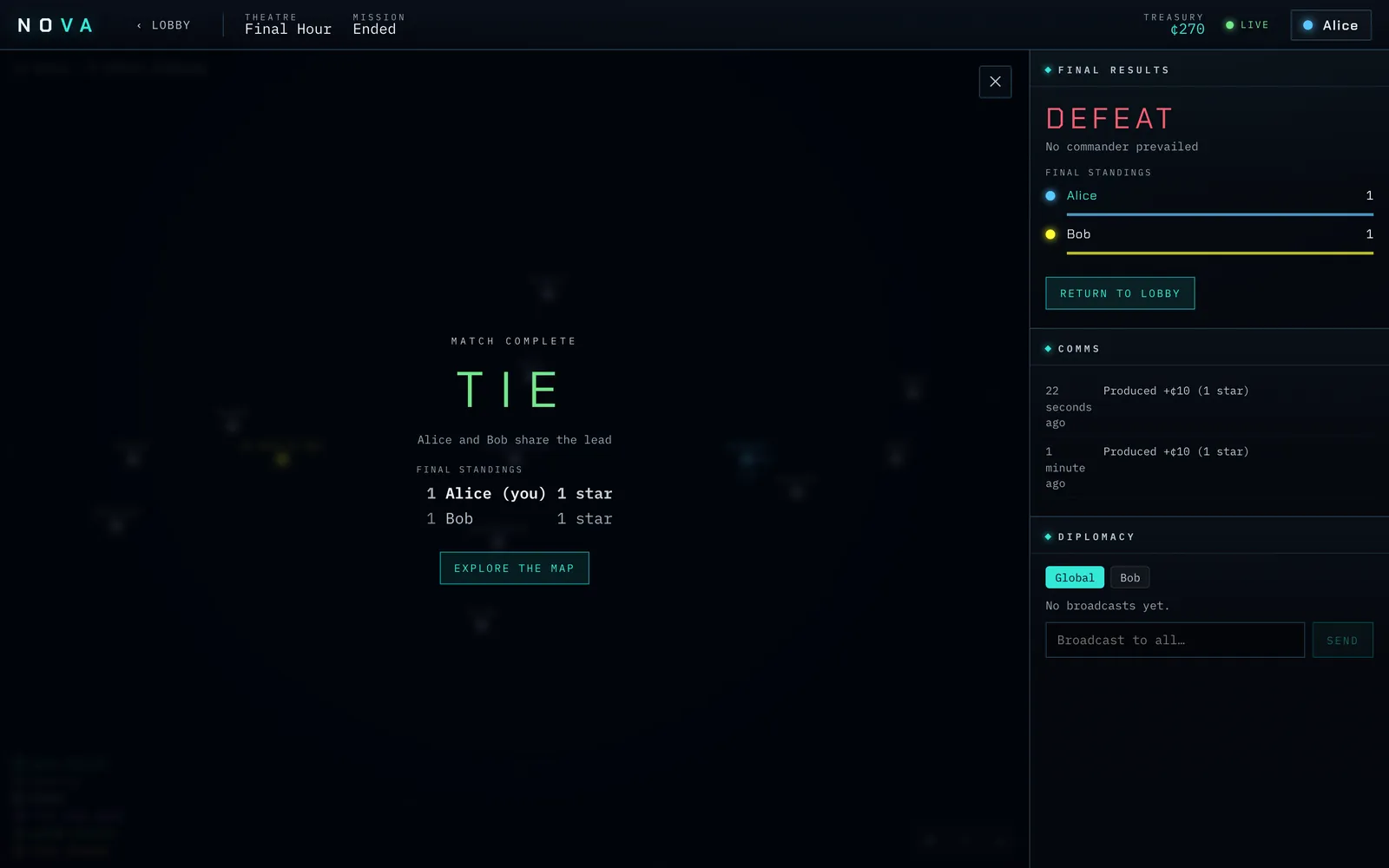
Screenshot: the Final results panel reading VICTORY, TIE, or DEFEAT, the result
line ("
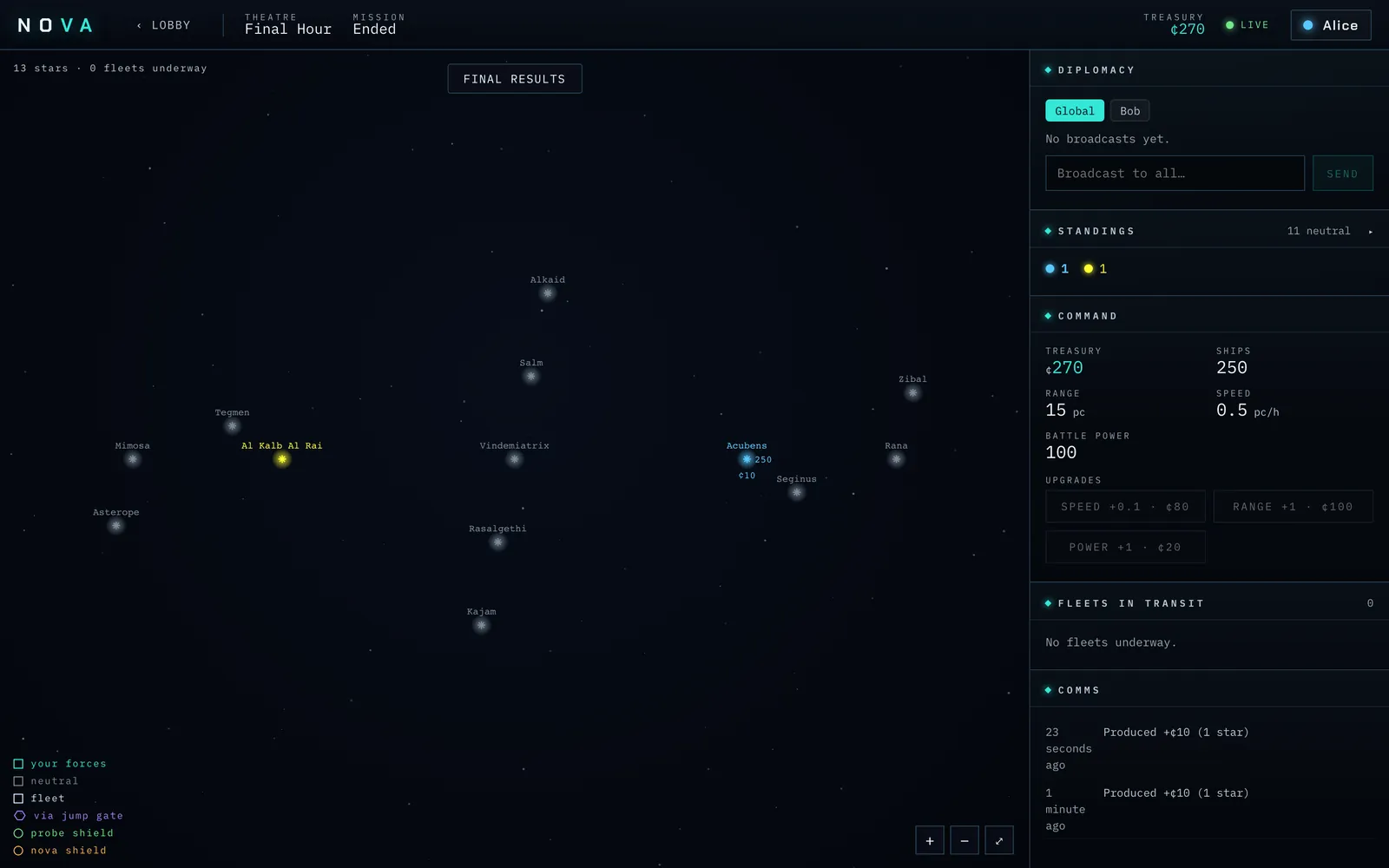
Screenshot: a star selected after the game has ended — its details in place of the summary, a Back control to return to the standings, and the status bar reading "Mission: Ended".
What this means for how you play
The win condition quietly shapes every decision:
- Breadth beats depth — at the end. Ten lightly held stars beat three fortresses when the bell rings. A massive garrison on a single world is only worth one star in the final count.
- Tempo matters. Because the deadline is fixed, the question is always "can I convert this into more stars before time runs out?" An attack that pays off next cycle is worth more than one that pays off after the game is over — indeed, Nova will not let you launch a fleet that cannot arrive before the deadline.
- Denial is a real strategy, but a costly one. A nova bomb removes a rival's star from their total — but it removes it from the map entirely, so you cannot capture it yourself. Destroy stars to deny a lead you cannot otherwise overcome, not as a path to growth. Note, too, that reducing every rival to zero living stars ends the game immediately in your favour — so capturing a rival's last star is far more decisive than bombing it (a bomb leaves the star dead and may not be the last one standing).
- The last few cycles are decisive. Stars captured late still count; stars lost late still hurt. Many games are decided by a final wave of attacks timed to land just before the mission ends — and by the garrisons you kept back to weather your rivals doing the same. And if one of those late attacks happens to take a rival's last living star, the game can end there and then, before the clock does.
A simple game plan
If you want a reliable approach for your first games:
- Expand early. Grab nearby neutral stars while they are cheap to take.
- Build factories on the safe stars you capture, so your fleets and treasury compound.
- Scout before you fight so you never waste a fleet.
- Automate your rear with standing orders feeding the front.
- Count stars, not battles. As the clock winds down, spend everything on holding and taking stars, and time your final pushes to land before the deadline.
Do those five things and you will be competitive in any theatre. The Strategy and Tactics chapter goes further.